Pearl FP8 Fork: How PRL Mining Moves to Floating Point and Who Stays on the Network
۱۴۰۵/۷/۱۵
Updated October 7, 2026. No activation date or block has been set for the fork.
Kryptex Pool supports every Pearl fork, including future ones, to keep the network secure and stable. You can follow fork news on our site: pool.kryptex.com.
⚡ TL;DR
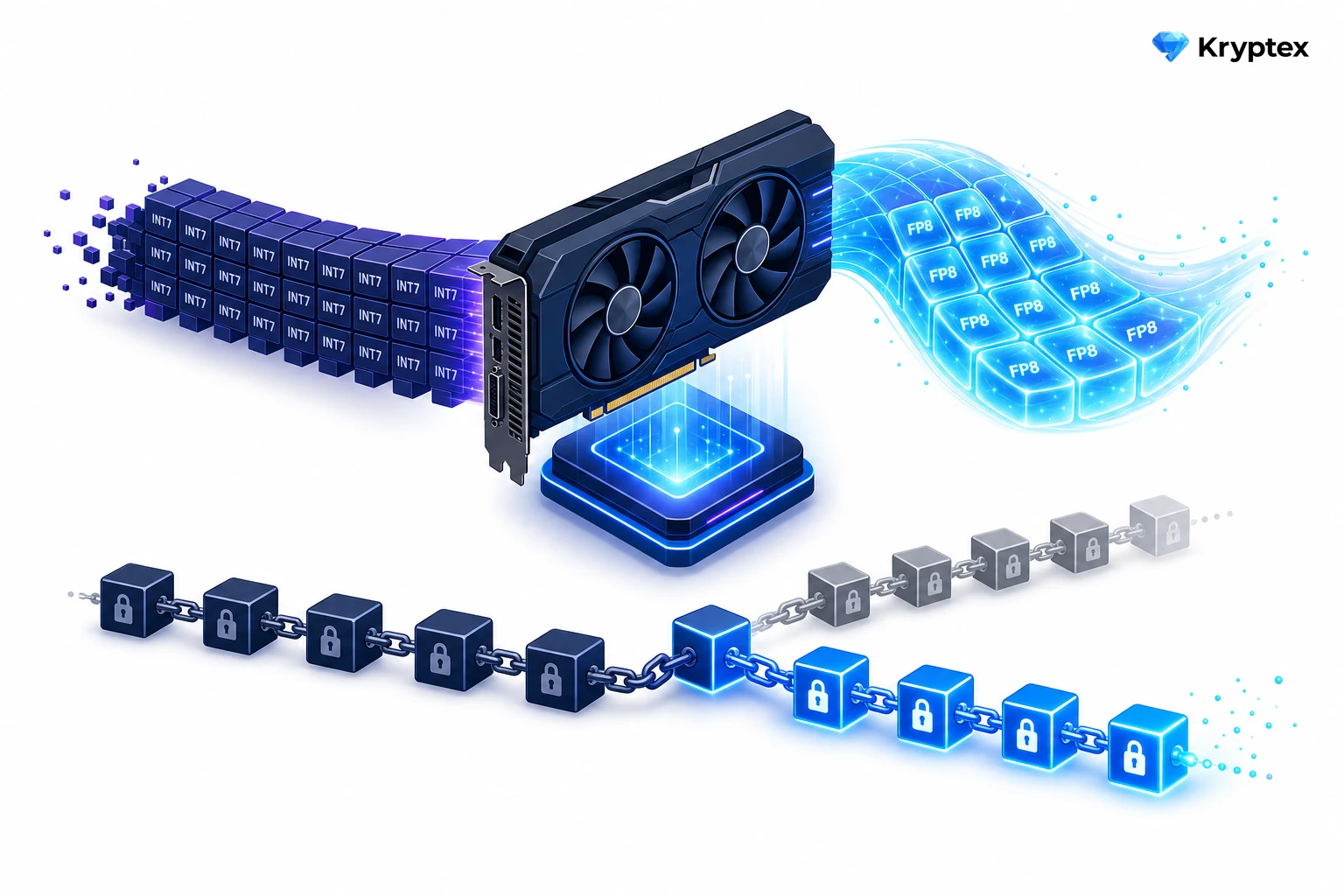
- Pearl (PRL) is preparing a hard fork: mining moves from integers,
INT7 × INT7 → INT32, to floating point,FP8 × FP8 → FP32. The spec is PIP-3, status: Draft. - Old nodes will not accept the new certificates, so every node has to upgrade.
- The PIP-3 certificate defines two device types: NVIDIA Hopper and NVIDIA Blackwell. Ampere (RTX 30 series), Turing (RTX 20 series), Ada (RTX 40 series), and AMD are not in the spec.
- At the September 15 AMA, a Q&A session, the founders confirmed that the RTX 5090 and RTX PRO 6000 Blackwell will keep mining after the FP8 fork.
- No date is set: the team will upgrade the network once it is confident in the implementation's security. FP4 will come later, alongside FP8, not instead of it.
🧠 Mining That Computes Neural Networks
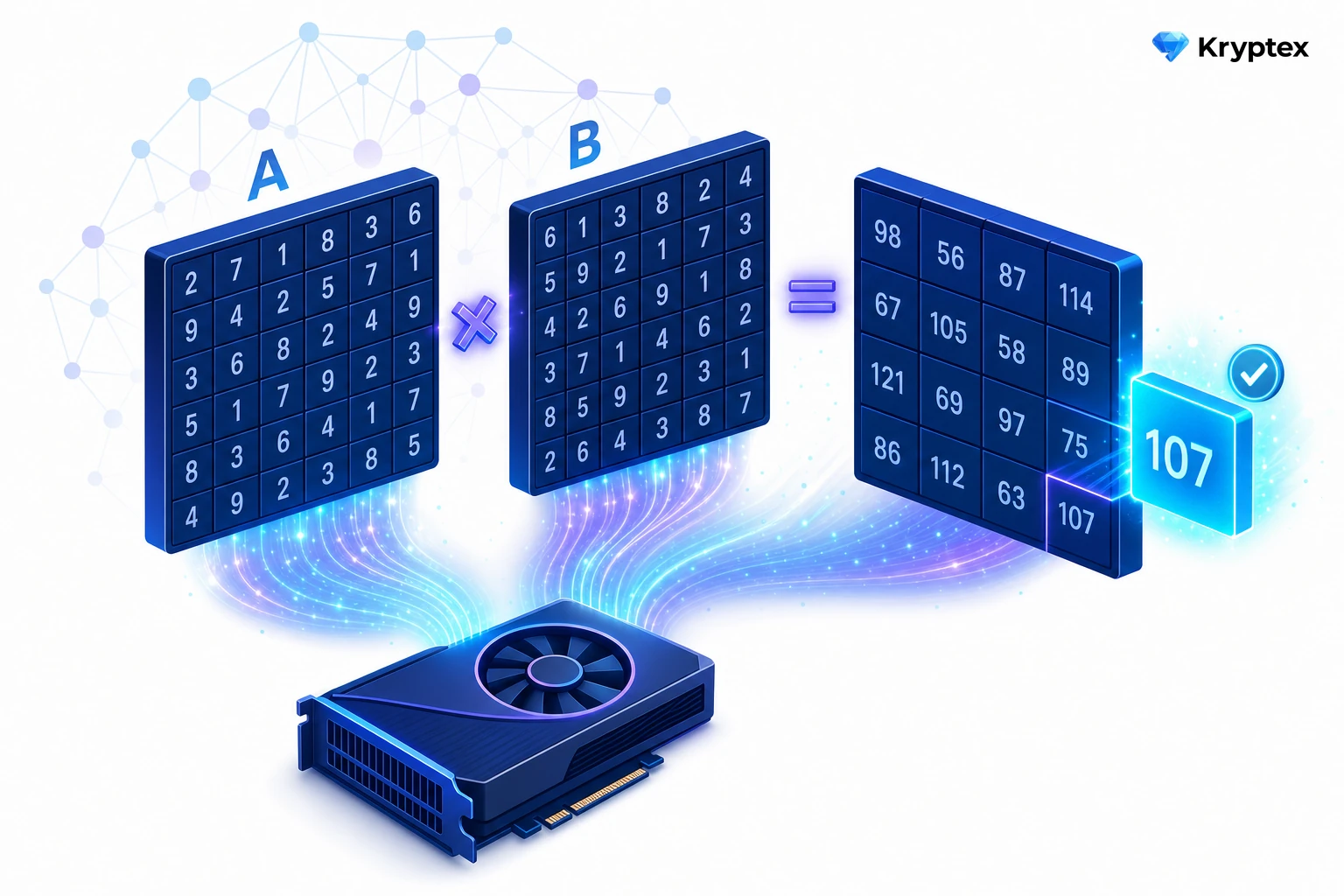
Pearl is a blockchain where a GPU does not grind through hashes but performs the same math it uses to run an AI model, such as a chatbot. In ordinary mining, only the network needs the result. In Pearl, the GPU multiplies large tables of numbers (matrices), and that multiplication is the proof of work.
Every AI model contains a huge set of such tables, called weights. To answer your question, the model multiplies your data by them again and again. That is why AI needs powerful GPUs, and why Pearl chose this operation.
Here is how it works. The miner takes the model's weights and the input data, or builds the tables itself when no real AI job is available. To stop anyone from sending an empty shell, the protocol mixes "noise" into the tables and subtracts it after the multiplication. The result is split into small pieces called tiles. If a tile's hash falls below the target, the miner has found a share. Shares go into a certificate that the network checks.
➗ Integers and Fractions
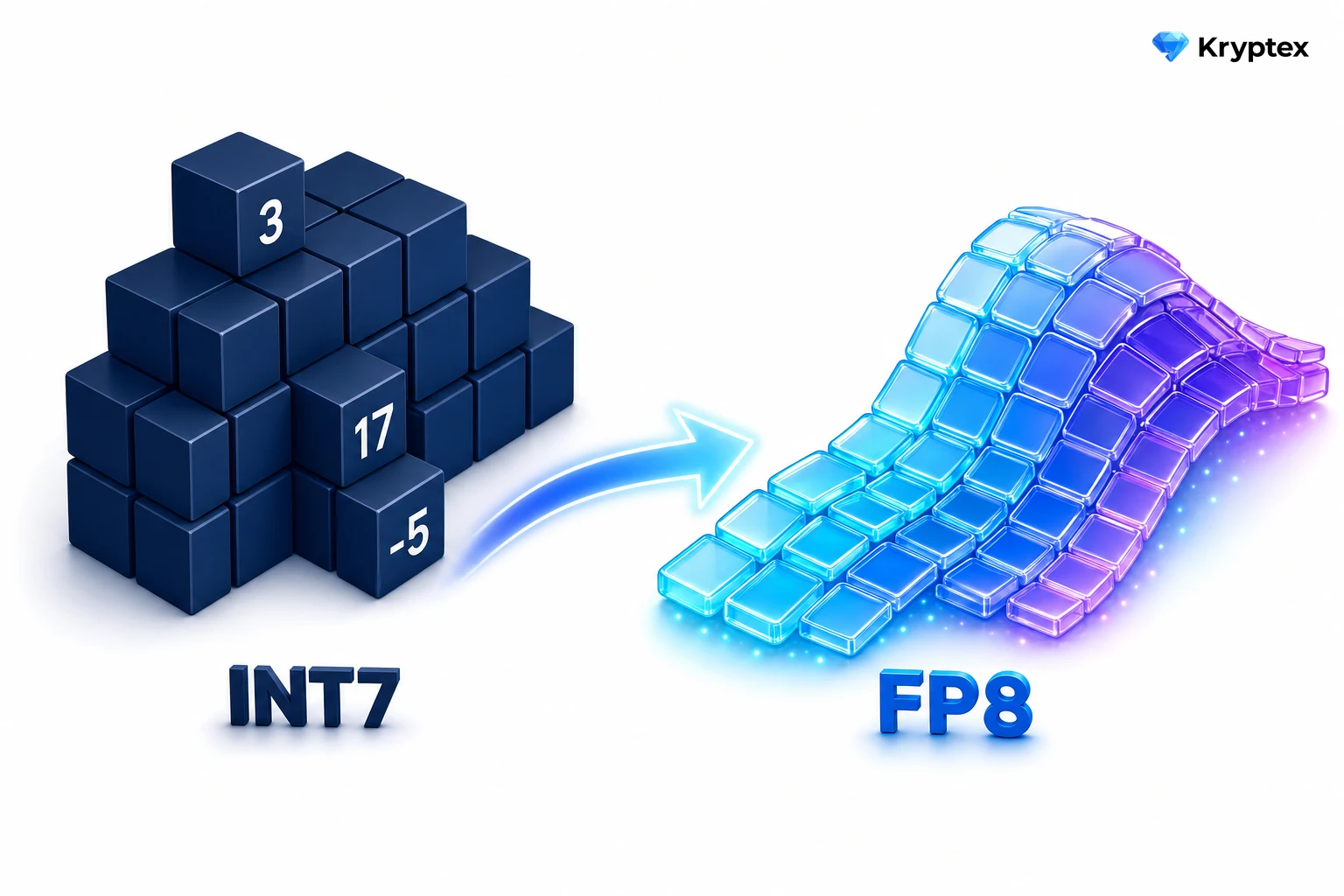
Today Pearl computes in integers (INT), or whole numbers: 3, 17, −5. The format is called INT7, and the running total is kept in INT32. Whole numbers keep things simple: every GPU gives the same answer down to the last bit, so the network can verify anyone's result.
But AI model weights are stored as fractions, such as 0.0003 or 150.25. This format is known as floating point (FP). To mine in integers, the miner rounds the model's weights to INT7, a step called quantization. FP8 is a compact way to write a fractional number in just 8 bits. After the fork, the miner computes in a format closer to the format that AI models themselves use.
🔬 What PIP-3 Changes
The new scheme in PIP-3 works like this:
- Input tables arrive in BF16 and are converted to FP8 (E4M3) row by row before multiplication. Each row's scale is written into the certificate.
- The noise is also FP8. BLAKE3 generates it from the tables' hashes, so a miner cannot choose the noise.
- The numbers are multiplied in FP8, and the running total is kept in the more precise FP32.
- The certificate has a
devicefield:0for Hopper,1for Blackwell.
With fractions, the answer depends on the GPU: different chips round differently, so results drift slightly apart. The PIP-3 authors reject any tolerance for that drift: it would let a miner nudge an answer to get more chances to find a share without extra computation (a grinding attack). So the network tolerates no difference. The spec writes down exact rounding rules for each GPU type, and every answer is checked against them. That is where the whitelist comes from: only device types with written rules make it into a certificate.
🎯 Why the Fork
The PIP-3 authors give two reasons. First, AI models natively work with fractions, and rounding to integers exists only for mining. Second, mining and useful AI work run on the same operation, so the extra cost is small. By the founders' account (AMA), the extra cost is 5–7% per table multiplication and lower across the whole model run, effectively zero in some tests. These are the team's own estimates, not independent benchmarks.
The price is lock-in to specific GPUs: PIP-3 calls this dependence unavoidable for floating point.
FP4, an even more compact 4-bit format, is not part of this fork. It will be added alongside FP8; the developer estimated a couple more months of work but gave no release date.
🎮 Who Stays on the Network
The PIP-3 certificate distinguishes two device types. The grouping of other cards below is our inference from chip capabilities (NVIDIA Compute Capability list).
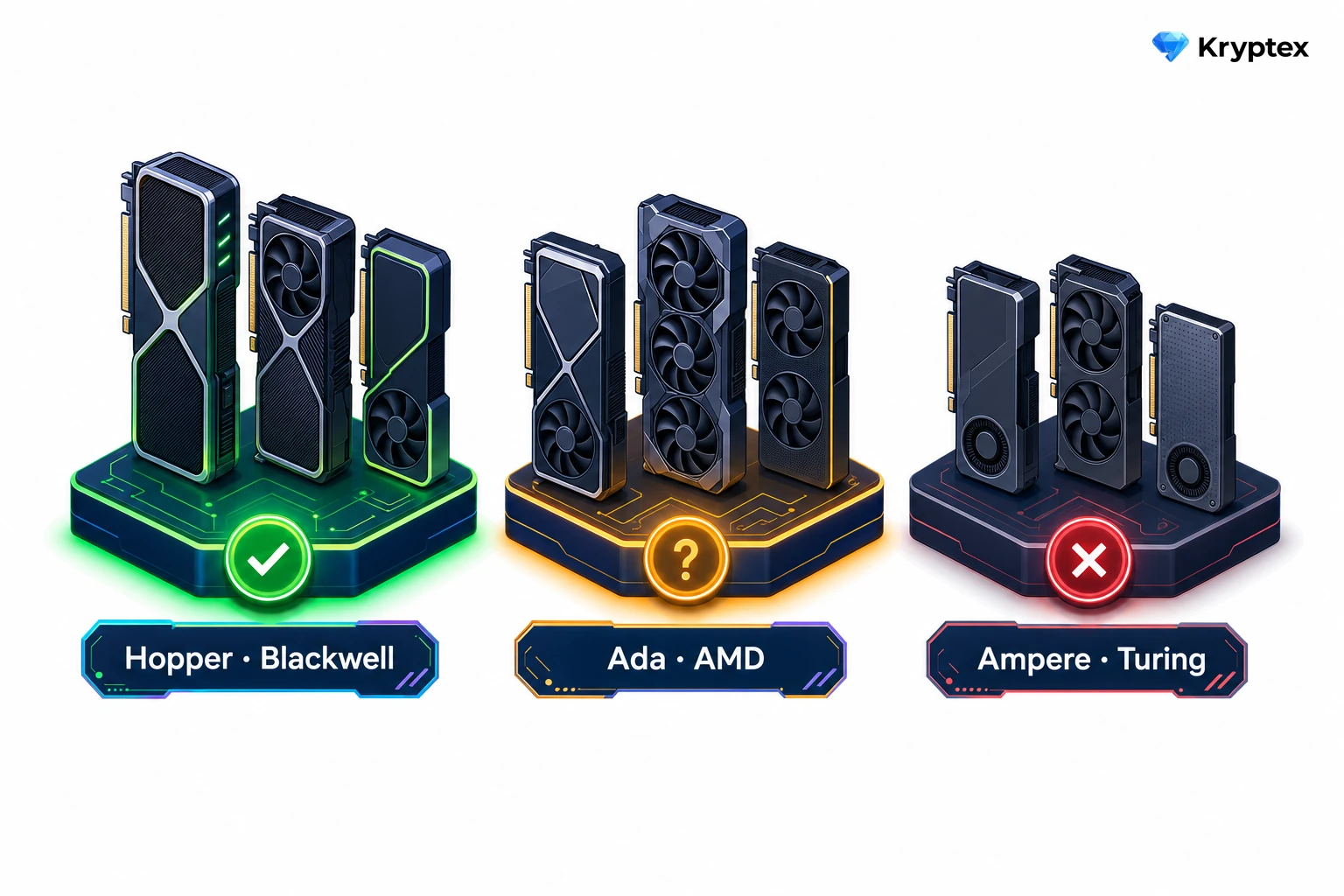
🟢 Hopper and Blackwell: built into the protocol. At the AMA, the founders confirmed that the RTX 5090 and RTX PRO 6000 Blackwell will work after the fork and will support the future FP4 upgrade. Hopper (H100) missed the first code release because of how it handles certain 32-bit operations; support landed on September 27, 2026 (PR #337). Neither PIP-3 nor the AMA gives a full compatibility list, so the node release will settle the exact set.
🟡 Ada and AMD: FP8 in hardware, not in the protocol. Ada Lovelace (RTX 40 series, L4, L40, L40S) and AMD cards with hardware FP8 (MI300, MI350, RDNA4) can compute in FP8, but PIP-3 has no profile for them. At the AMA, the founders said that in the long run they want to phase out very old GPUs that cannot handle floating-point workloads, but they gave no timetable or full exclusion list.
🔴 Ampere, Turing, and older AMD: no hardware FP8. That covers the RTX 30 and RTX 20 series, the A100, the CMP 170HX and CMP 90HX mining cards, and AMD's RX 6000 and RX 7000 series.
Community members propose workarounds, such as an FP16 mode for the A100 (PR #369). These are contributor initiatives, not network decisions.
📅 When Will the Fork Happen
There is no date. PIP-3 is still a Draft, and it doesn't specify an activation height. At the AMA, the founders said they will upgrade the network once they are confident in the implementation and its security. If doubts remain, there will be no fork.
✅ What Miners Should Do
- Hopper and Blackwell: the fork opens FP8 mining to them. Watch for the node and miner releases that support the new certificate.
- RTX 40, 30, and 20 series, CMP, and AMD cards: mining continues as usual until the fork. After activation, under the current PIP-3, these cards cannot produce valid certificates. Factor that risk into your payback estimates.
- At fork time, update your miner to a version that supports the new protocol.
- Where to watch: Kryptex Pool, the PIP repository, and Pearl releases.
⛏ How to Mine PRL Now
Until the fork, PRL mines as usual. To start on Kryptex Pool, you need three steps:
- Wallet. Create a PRL address with this guide.
- Miner. Pick a miner in the Pearl miners overview.
- Connection. Enter your wallet address and worker name on the PRL pool page, then start the miner with the server address
prl.kryptex.network:7048.
For a full walkthrough, see How to mine Pearl (PRL).
❓ FAQ
Will the RTX 5090 and RTX PRO 6000 Blackwell mine? Yes. The founders confirmed both cards at the AMA.
Will the RTX 4090 mine after the fork? Not under the current PIP-3: the certificate admits only Hopper and Blackwell. The founders did not comment on the 4090 specifically.
Will the RTX 3090 and other RTX 30 cards mine? No, based on the current spec: these chips have no FP8 hardware, and PIP-3 lists no Ampere profile.
When is the fork? No activation date or block has been set.
Does Kryptex Pool support the FP8 fork? Yes. We support every Pearl fork, including future ones, to keep the network secure and stable. Follow fork news at pool.kryptex.com.
Need Help?
Have any questions, something unclear, or trouble connecting?
Contact support — we're happy to assist!
- Support Ticket.
- Telegram Support.
- Discord Support.
- Email support at support@kryptex.com.